ONE News
From the Road to Gilead and back to Section 28? Why we need #SaferToBeMe
The North East has always been a region with a strong sense of community, solidarity and identity. However, in recent months, we have also seen growing political and public debate and vision around LGBTQ+ visibility, inclusion, and our place within public life.
Earlier this year, before we began our Summer of Pride programme of celebrations and activities, decisions were taken locally to restrict the flying of Pride flags and withdraw council funding from Pride activities. While views on such decisions will inevitably differ, for many LGBTQ+ people they raised wider concerns about visibility, belonging, and whether our communities continue to feel represented within the places we call home.
These debates have also been reflected on social media and within wider political discussion. LGBTQ+ people and organisations are increasingly finding themselves at the centre of conversations about community values, education, literature, and public spaces. Proposals have included calls to restrict LGBTQ+ materials within libraries, despite little evidence of local concern about their availability.
Political disagreement is part of a healthy democracy. However, it is important that these discussions do not result in LGBTQ+ people being presented as separate from the communities in which we live. LGBTQ+ people are neighbours, colleagues, family members, volunteers, business owners, students, and community leaders. We are part of the North East, and our region is strongest when people from different backgrounds are able to participate fully in its civic and community life.
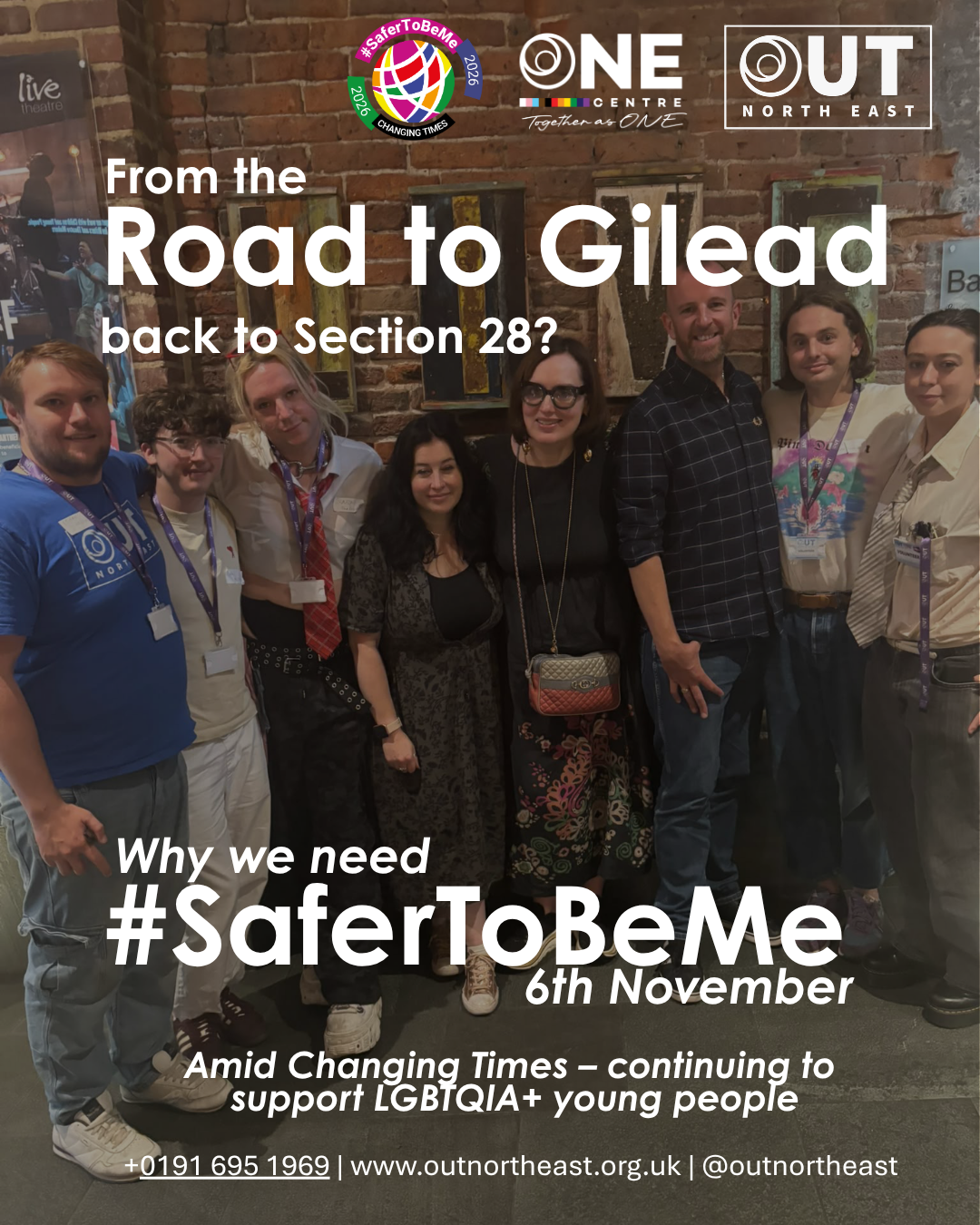
This was particularly evident over the weekend, when OUT North East partnered with Amnesty Feminist to bring the award-winning podcast The Guilty Feminist to Newcastle alongside the Road to Gilead Open Space event. Both events were held at Live Theatre and demonstrated something that can sometimes be overlooked, that the North East has an active, passionate, and diverse community that is committed to positive social change.
Both events were close to capacity or sold out. They brought together people from different backgrounds and communities to discuss the challenges facing our region and, importantly, what we can do collectively to respond to them. Some attended as representatives of organisations, while others came simply as individuals wanting to listen, contribute, and connect.
For OUT North East, this was an important reminder that community is not simply an abstract idea. Community is created when people come together, share experiences, listen to one another, and consider how we can make our region more welcoming and inclusive.
The Road to Gilead Open Space particularly demonstrated the breadth of knowledge, experience, and commitment that exists across the North East. Our region is home to charities, voluntary organisations, activists, community groups, businesses and individuals who are working every day to support others and create positive change. While there are undoubtedly challenges ahead, there is also a significant network of people prepared to meet them.
That spirit is something we hope to continue through #SaferToBeMe2026. With this in mind, OUT North East is partnering with ReportOUT to bring back the #SaferToBeMe2026 conference to the region, and to hold it at the ONE Centre. At a time when many LGBTQ+ people, particularly LGBTQ+ younger people, may feel uncertain about the social and political conversations taking place around them, we believe that creating opportunities for meaningful discussion is increasingly important. With a theme of younger LGBTQ+ people amid uncertain times, this day-long conference is needed more than ever.
The conference will bring together both younger LGBTQ+ people with those who remember and who experienced the challenges of previous decades, including the period of Section 28. Alongside them will be organisations, businesses, community leaders, allies, and others committed to creating a safer and more inclusive future.
This is not simply about looking backwards. Understanding previous generations' experiences can help us think more carefully about our present and the future. #SaferToBeMe2026 will create space for conversations that cannot always be captured through a news headline or social media post, which includes conversations about belonging, resilience, community, safety, and what practical action can be taken to support younger LGBTQ+ people.
Perhaps the most encouraging part of the weekend at Live Theatre was seeing how many people were willing to give their time, ideas, and energy to those conversations. It demonstrated that, even during uncertain times, there remains a strong appetite across the North East to bring people together rather than allow differences to push communities further apart.
We hope to recreate some of that spirit at the ONE Centre for #SaferToBeMe2026. If somebody leaves the conference feeling more connected, better informed, more confident in supporting LGBTQ+ young people, or simply reassured that there is a community around them, then that is what matters.
The North East faces challenges, but it also has considerable strengths. Our communities, organisations, and people, are among them. By continuing to create spaces where people can meet, learn from one another, and work together, we can help ensure that LGBTQ+ people remain a visible, valued and integral part of the region we are all proud to call home.
To book your place or find out more about #SaferToBeMe2026, including our programme of speakers, discussions and activities, please follow the link below.
https://www.reportout.org/safertobeme2026
By Ethan Henderson
Digital Outreach Officer